
The Ghost Human Species Living Inside Us
Oct 19, 2026
By: Greg Schmalzel
What if I told you that a completely unknown human species may still be living inside you? Scientists recently found evidence that some people have inherited genetic material from an ancient human population that we have never actually identified. We don’t know who they were, what they looked like, or when they went extinct. But the genetics prove they existed.
What really shatters our understanding of these phantom ancestors is that not a single bone has ever been found. When we study other species like Neanderthals or Denisovans, we often have an abundance of fossils to examine. Their skulls, teeth, and ancient tools allow us to reconstruct their world. But this ghost lineage left us with zero fossils. So who were these mysterious humans, and why can’t we find them?
Click here for the full YouTube video.
Click here to sign up for my free newsletter.
Ancient DNA
Mahuli96
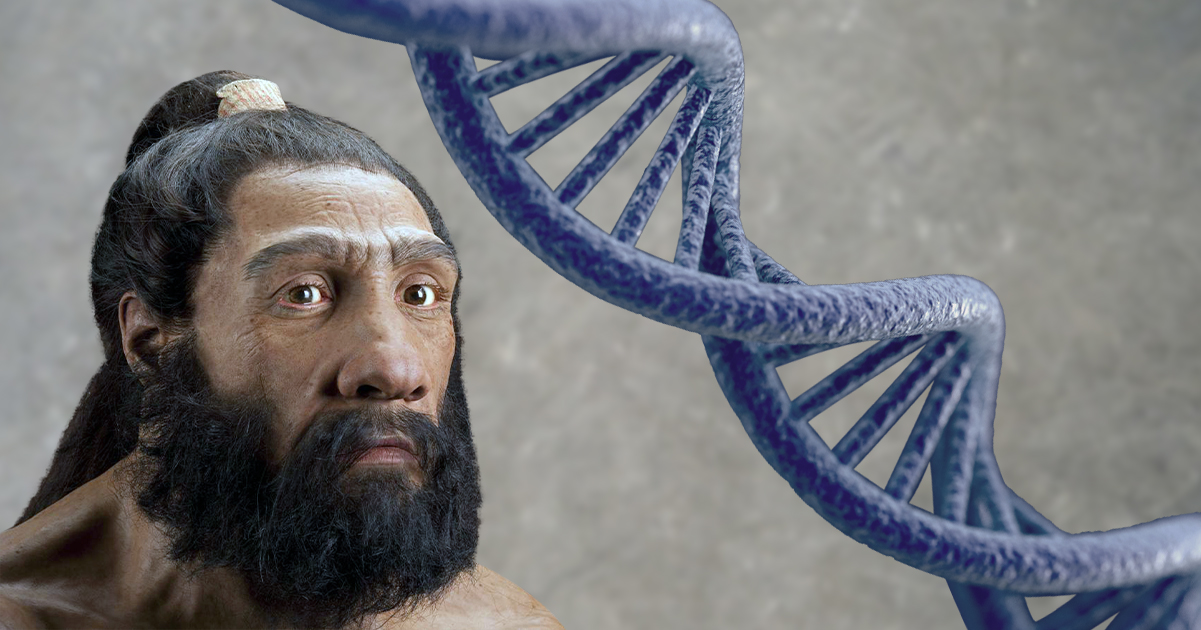
We think of ourselves simply as “human,” but Homo sapiens is just one branch of a much larger human family tree. Other human species once lived across the world, and some left traces in our DNA. Neanderthals contributed roughly 1–4% of the DNA found in many non-African populations, while Denisovans contributed up to 6% in some populations across Oceania. Some of these inherited genes helped humans adapt to new environments, while others may increase disease risk. Denisovan DNA even helped Tibetans survive at high altitudes. But these discoveries have largely focused on populations outside Africa. So what happens when we look more closely at Africa?
Discovering the Ghost Species
Durvasula, A. and Sankararaman, S. 2020.
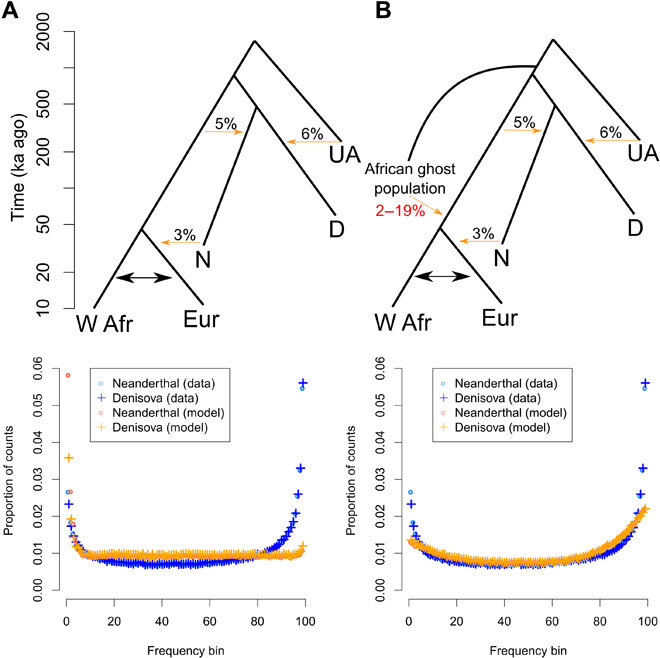
This is where our ghost population comes into play. Researchers at UCLA analyzed whole-genome data from four West African populations: Yoruba, Esan, Gambian, and Mende. They compared patterns of genetic variation with Neanderthal and Denisovan genomes, looking for signs of DNA from an unknown archaic population.
They used a statistical tool called the conditional site frequency spectrum, or CSFS. It examines genetic variants found in archaic genomes and asks how common those same variants are among modern West Africans. If these populations had simply split apart without mixing again, the variants should be distributed fairly evenly. Instead, the researchers found a striking U-shaped pattern, with unusually large numbers of variants at both the rare and common ends. The same pattern appeared across all four populations, supporting the idea that an archaic population had contributed DNA to their ancestors.
The researchers then tested different explanations. Models A and B proposed ghost populations that split from either the modern-human or Neanderthal line after those groups had already separated. Neither fit the data well. Model C did: it proposed that the ghost population diverged from the ancestors of both modern humans and Neanderthals before their split. The researchers estimated this divergence at roughly 625,000 years ago, with gene flow into the ancestors of modern West Africans occurring around 43,000 years ago. Their models estimated roughly 2–19% archaic ancestry.
To identify individual DNA segments, they also used a machine-learning tool called ArchIE. It flagged roughly 7% of the Yoruba and Mende genomes as potentially archaic, with some segments occurring at frequencies approaching 85%. In other words, we may be able to reconstruct parts of a human population that left almost no fossils—simply by reading the DNA of people living today.
The Fossil Problem
John Reader
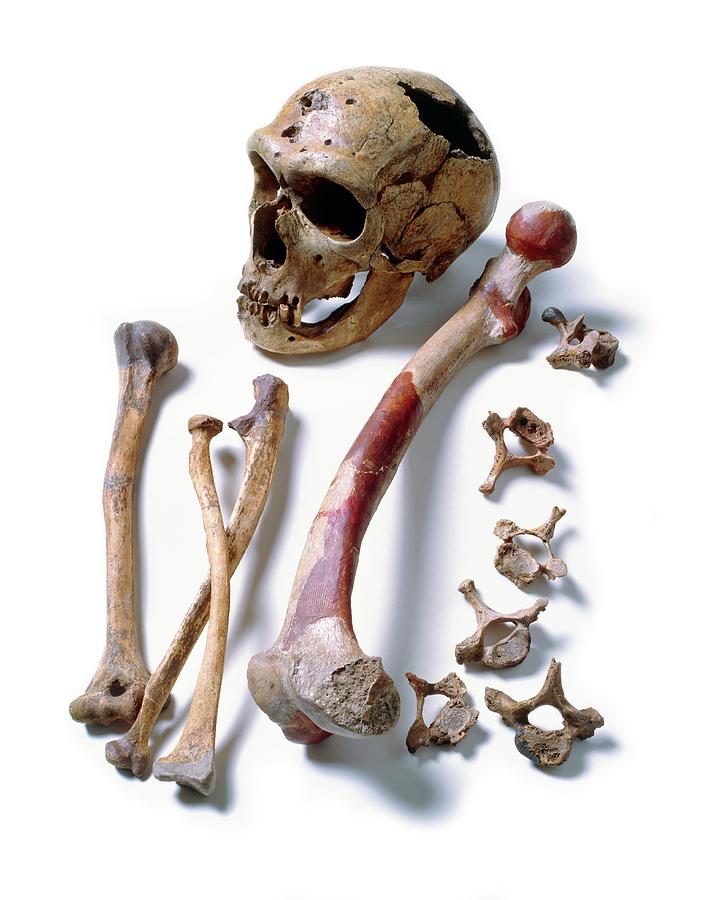
The fossil record is heavily filtered. Most bodies never become fossils because decomposition, scavengers, weather, and erosion destroy them long before preservation can begin. Rapid burial is one of the most important steps, protecting bones from the environment. This is one reason East Africa has produced so many hominin fossils: ancient lakes and rivers repeatedly deposited sediments that buried and preserved remains.
Even after burial, chemistry can destroy bone. Acidic groundwater can dissolve the calcium-rich minerals that give bone its structure, while dry, cold, or chemically stable environments are often more favorable for preservation. Eventually, erosion becomes the final filter. It can destroy fossils, but it can also expose them. A fossil must survive long enough to be revealed, and researchers must happen to be looking in the right place.
This helps explain West Africa’s enormous gap in the hominin fossil record. The Iwo Eleru site in Nigeria is the only known terminal-Pleistocene hominin fossil site in tropical West Africa. The remains, dating to roughly 11,000–16,000 years ago, show unusual physical features that may reflect isolation, although their connection to the ghost population remains speculation.
Geology and climate may explain part of the problem. Much of West Africa lacks the thick, fossil-rich sedimentary basins found in East Africa, while tropical forests bring heavy rainfall, acidic soils, rapid decomposition, and dense vegetation that makes fieldwork difficult. And there is another filter: scientists have historically spent far more time and money searching East and South Africa. West Africa may not be missing human history—it may simply be missing the geological and scientific conditions needed to reveal it.
Ancient Ghost Technology
Nicholas, T. 2022.
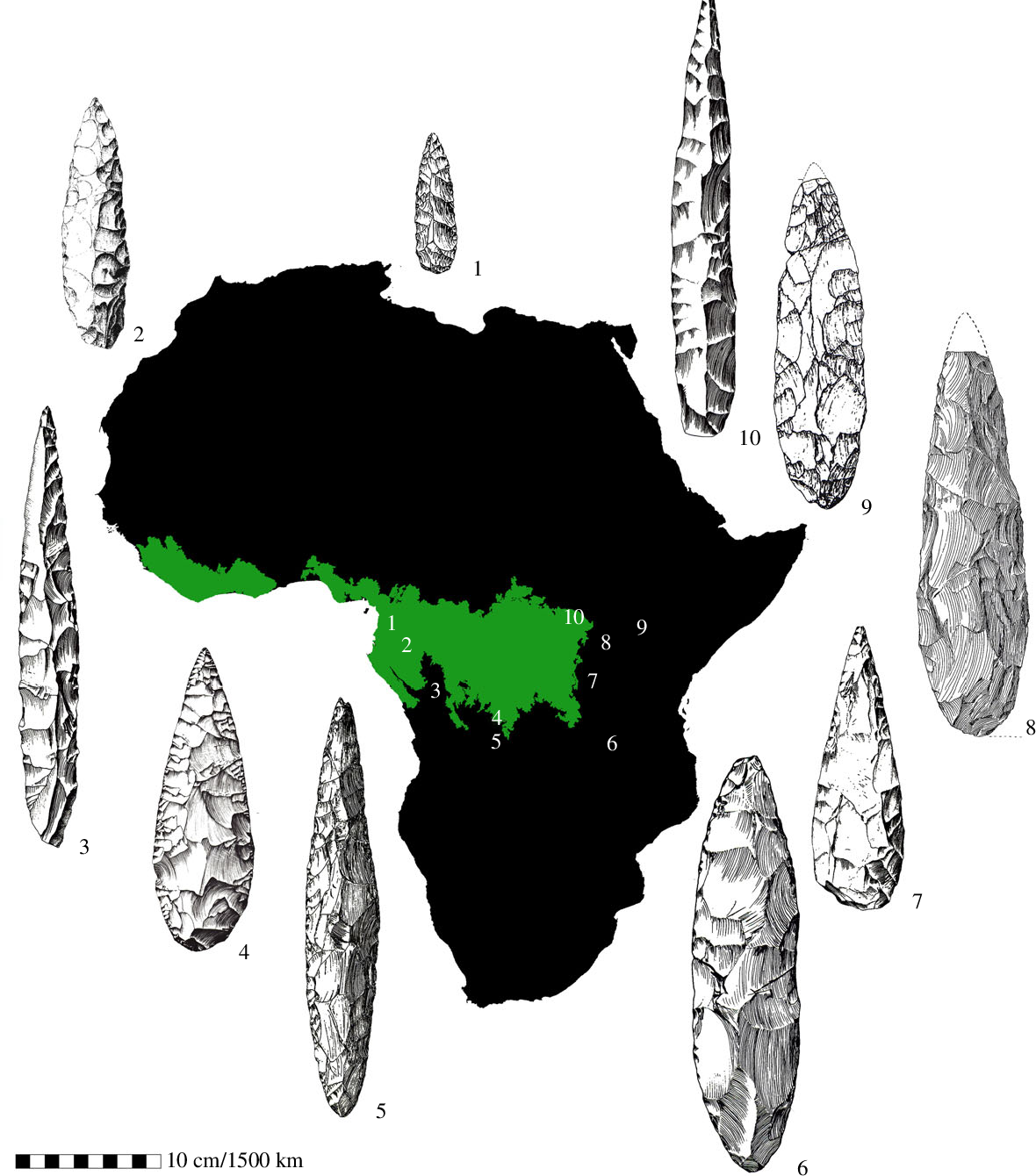
But physical evidence doesn’t end with fossils. Stone survives far better than bone, so researchers can also look at the tools left behind by hominins who lived in West Africa during the Middle Stone Age.
We can’t directly connect these tools to the ghost population, but a 2023 study identified a Middle Stone Age site at Bargny, Senegal, dating to roughly 150,000 years ago. Plant remains show that Bargny was a wetland refuge during an otherwise dry period, providing hominins with reliable water and resources. The stone tools included Levallois technology, a sophisticated method of shaping a stone core to produce predictable, razor-sharp flakes.
What makes Bargny especially interesting is how long this technology persisted in West Africa. Similar tools were still being produced at Ndiayène Pendao roughly 11,600 years ago, suggesting that Levallois traditions survived there for more than 100,000 years after they had largely disappeared elsewhere in Africa.
Even older evidence comes from the Lupemban industry, dating to roughly 170,000–270,000 years ago. Its distinctive lanceolate points are large, symmetrical, and unusually heavy. Some researchers have suggested they may have been used as thrusting weapons or tools for working within dense forests. If so, they could provide a glimpse into how ancient hominins adapted to West Africa’s tropical environments.
None of this proves that the ghost population made these tools. But when combined with the genetic evidence and the unusual Iwo Eleru remains, it begins to paint a picture of a population adapted to the forests and wetlands of West Africa—one that may have remained isolated from other human populations for immense stretches of time.
And this raises an even bigger question: could this ghost population actually have been Homo erectus—or another archaic human we already know?
Sources:
[1] Green, R., et al. 2010. “A draft sequence of the Neandertal genome.” Science 328(5979):710-722.
[2] Neanderthals' Genetic Legacy: Humans inherited variants affecting disease risk, infertility, skin and hair characteristics
[3] Reich, D., et al. 2010. “Genetic history of an archaic hominin group from Denisova Cave in Siberia.” Nature 468, 1053–1060.
[4] Huerta-Sánchez, E., et al. 2014. “Altitude adaptation in Tibetans caused by introgression of Denisovan-like DNA.” Nature 512(7513):194-7.
[5] Roca-Umbert, A., et al. 2023. “Human genetic adaptation related to cellular zinc homeostasis.” PLOS Genetics 19(9):e1010950
[6] Villanea, F., et al., 2025. “The MUC19 gene: An evolutionary history of recurrent introgression and natural selection.” Science 389, eadl0882.
[7] Durvasula, A. and Sankararaman, S. 2020. “Recovering signals of ghost archaic introgression in African populations.” Sci. Adv.6, eaax5097.
[8] Stojanowski, C. 2014. “Iwo Eleru’s place among Late Pleistocene and Early Holocene populations of North and East Africa.” Journal of Human Evolution 75, 80-89.
[9] Harvati, K., et al. 2011. “The Later Stone Age Calvaria from Iwo Eleru, Nigeria: Morphology and Chronology.” PLOS ONE 6(9):e24024.
[10] Rosas, A., et al. 2022. “The scarcity of fossils in the African rainforest. Archaeo-paleontological surveys and actualistic taphonomy in Equatorial Guinea.” Historical Biology 34(8):1582–1590.
[11] Marchal, F, et al. 2025. “The hominin fossil record of the Omo-Turkana Basin.” J Hum Evol. 209:103731.
[12] Niang, K., et al. 2023. “Longstanding behavioural stability in West Africa extends to the Middle Pleistocene at Bargny, coastal Senegal.” Nat Ecol Evol 7, 1141–1151.
[13] Scerri, E., et al. 2017. “Persistence of Middle Stone Age technology to the Pleistocene/Holocene transition supports a complex hominin evolutionary scenario in West Africa.” Journal of Archaeological Science: Reports 11, 639-646.
[14] Nicholas, T. 2022. “Riddles wrapped inside an enigma. Lupemban MSA technology as a rainforest adaptation: revisiting the lanceolate point.” Phil. Trans. R. Soc. B 377(1849):20200484
[15] Yulin Zhang et al. 2026. “Recovering signatures of archaic hominin introgression using ancestral recombination graphs.” Science 393, eaef8874.
Founder