
How People Actually Got to The Americas
Apr 06, 2026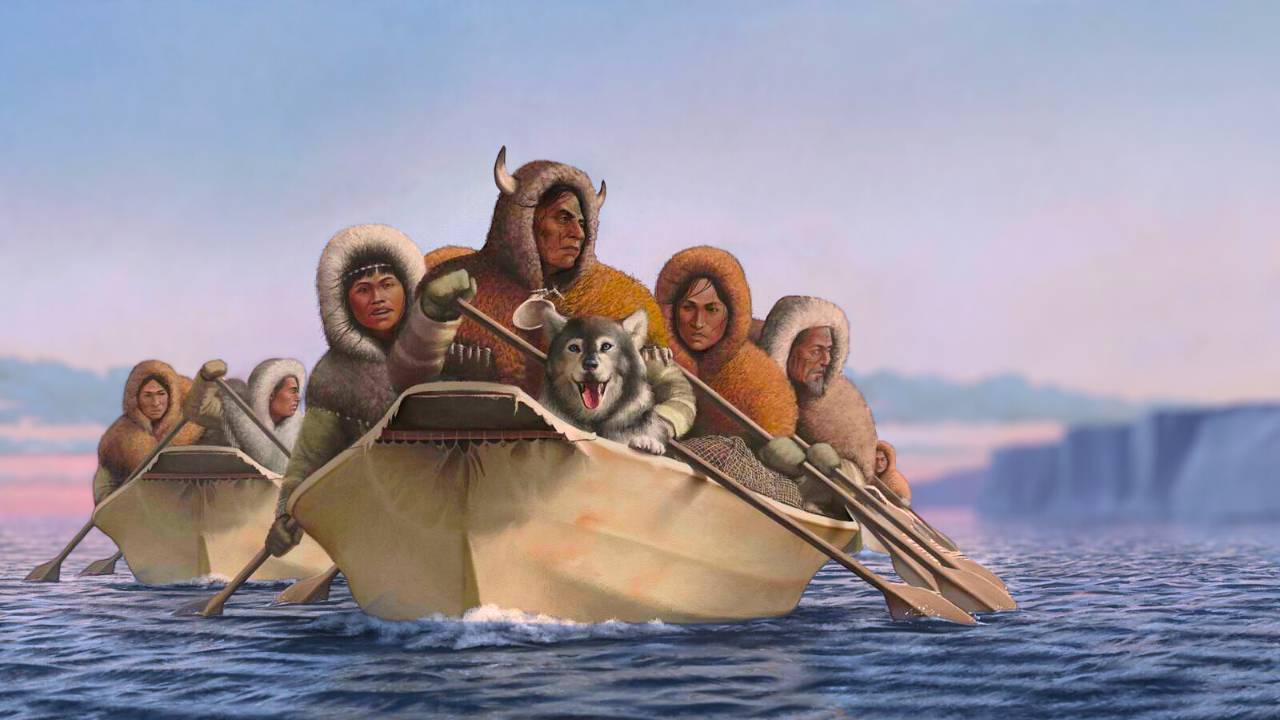
By: Greg Schmalzel
For most of human history, the Americas were the last great unknown. Our species spread across Africa, Europe, Asia, and even reached Australia tens of thousands of years before we made it to the Western Hemisphere. Massive ice sheets blocked people from getting to North America by land. Vast oceans separated South America from the rest of the world. We eventually made it here, but when and how this happened is unclear.
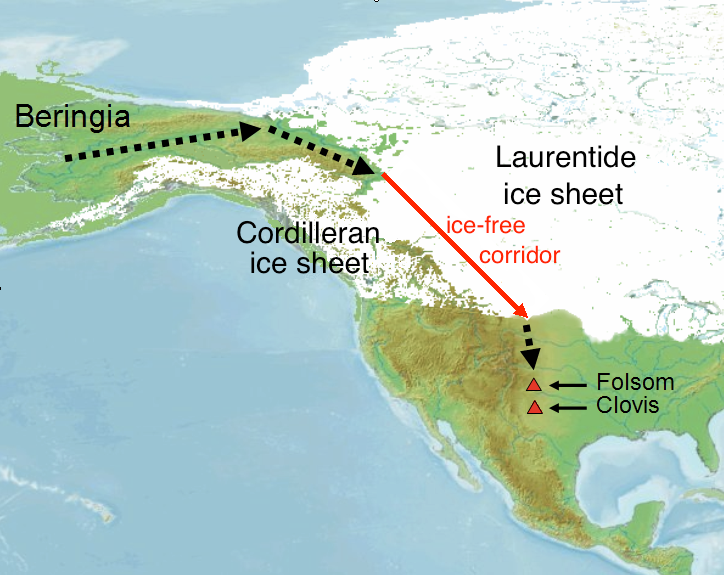
For decades, archaeologists believed they had the answer. The first Americans, they said, walked from Siberia into Alaska across a land bridge called Beringia. Then they traveled south through a narrow gap between two giant glaciers to finally enter the new landmass. This became the standard story taught in textbooks for generations.
But in recent years, new discoveries have started to challenge that idea. Some researchers have proposed some shocking alternatives. One is that the first Americans came from Ice Age Europe, crossing the Atlantic along frozen seas. Others think the real answer lies along the Pacific coast, where travelers relied on a very specific set of resources for survival. These are the three hypotheses most often thrown around, but which one is right? Which one does the evidence support? Let’s see for ourselves.
For the full YouTube Video, click HERE.
The Ice-Free Corridor and Clovis First
In 1908, a devastating flood struck Folsom, New Mexico. The next day, a cowboy named George McJunkin rode out to survey the damage. Born into slavery in 1851, McJunkin was self-educated and deeply curious about science. While exploring a nearby arroyo, he noticed large fossil bones eroding from the banks—far bigger than modern bison. He believed the site was important, but no one investigated before his death in 1922.
In 1927, archaeologists finally examined the site. They discovered a finely made stone spear point embedded among the bones of an extinct species, Bison antiquus. This proved that humans lived in North America over 11,000 years ago—far earlier than previously believed. The artifact became known as a Folsom point: a small, thin, fluted spear point crafted with remarkable precision.
Just a few years later, an even older discovery emerged. At Clovis, New Mexico, archaeologists found larger fluted points buried deeper in the soil alongside mammoth remains. These Clovis points pushed human presence in the Americas even further back, to around 13,000 years ago. From this, the “Clovis First” theory was born—the idea that the first Americans were big-game hunters who crossed a land bridge from Siberia into Alaska during the Ice Age and traveled south through an ice-free corridor.
Geological evidence shows this corridor began opening around 15,000 years ago as massive glaciers retreated. By about 13,500 years ago, ecosystems were forming, making migration possible.
But there’s a problem. Sites like Monte Verde in Chile, Meadowcroft Rockshelter in Pennsylvania, and ancient footprints at White Sands suggest humans were in the Americas thousands of years before Clovis.
The conclusion? Clovis may not mark the beginning—but just one chapter in a much deeper human story.
The Solutrean Hypothesis
Kilby, David. “A North American Perspective on the Volgu Biface Cache from Upper Paleolithic France and Its Relationship to the ‘Solutrean Hypothesis’ for Clovis Origins.” Quaternary International, vol. 515, 2019, pp. 197–207.
A closer look at Clovis stone tools reveals clues about their origins. Their most distinctive feature—the flute removed from the base—was made with a final, precise strike. Much of the shaping, however, relied on overshot flaking, a risky technique where a flake travels across the entire face of the stone, thinning it without reducing width. Interestingly, this same method appears in Ice Age Europe.
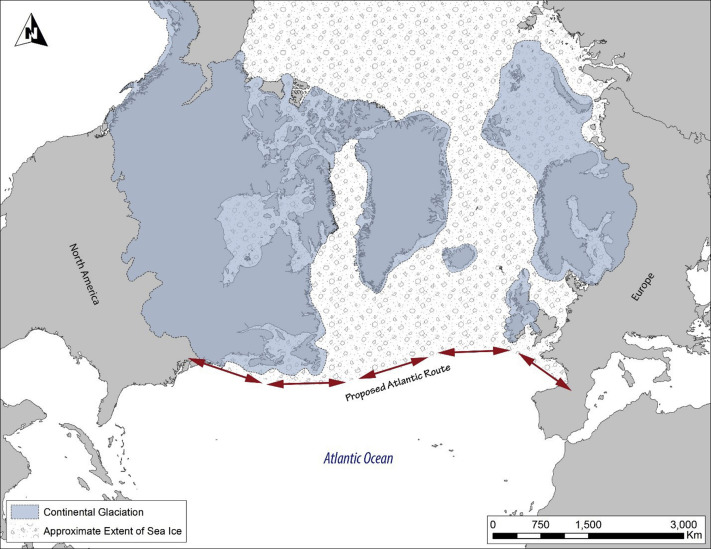
This connection inspired the Solutrean Hypothesis, which proposes that people from the Solutrean culture of present-day France and Spain (about 22,000–17,000 years ago) migrated to North America. Solutrean tools, especially their thin, symmetrical points, resemble Clovis technology. Researchers Dennis Stanford and Bruce Bradley argue that overshot flaking is too complex to have been independently invented twice—and notably, it’s absent in Siberia, the traditional migration route.
Some archaeological finds seem to support this idea. Artifacts from sites like Cactus Hill (Virginia) and Parsons Island (Maryland) suggest possible pre-Clovis occupations on the East Coast. The controversial Cinmar discovery—a stone blade dredged alongside mastodon remains dated to around 22,700 years ago—has also been cited as evidence of an early Atlantic presence.
There’s even limited genetic support. Mitochondrial haplogroup X2a, found in some Native American populations, appears more closely related to Western Eurasian lineages than Siberian ones.
However, the hypothesis faces major challenges. The genome of a Clovis child (Anzick-1) shows clear Siberian ancestry, with no European connection. There’s also a 5,000-year gap between the Solutrean and Clovis cultures, and little evidence that Solutrean people relied on marine resources needed for an Atlantic crossing. Environmental reconstructions suggest the proposed ice-edge route was harsh, seasonal, and likely unviable.
Today, most archaeologists reject the Solutrean hypothesis. But the mystery remains: if not through the corridor—or across the Atlantic—how did the first Americans arrive?
The Kelp Highway Hypothesis
National Geographic
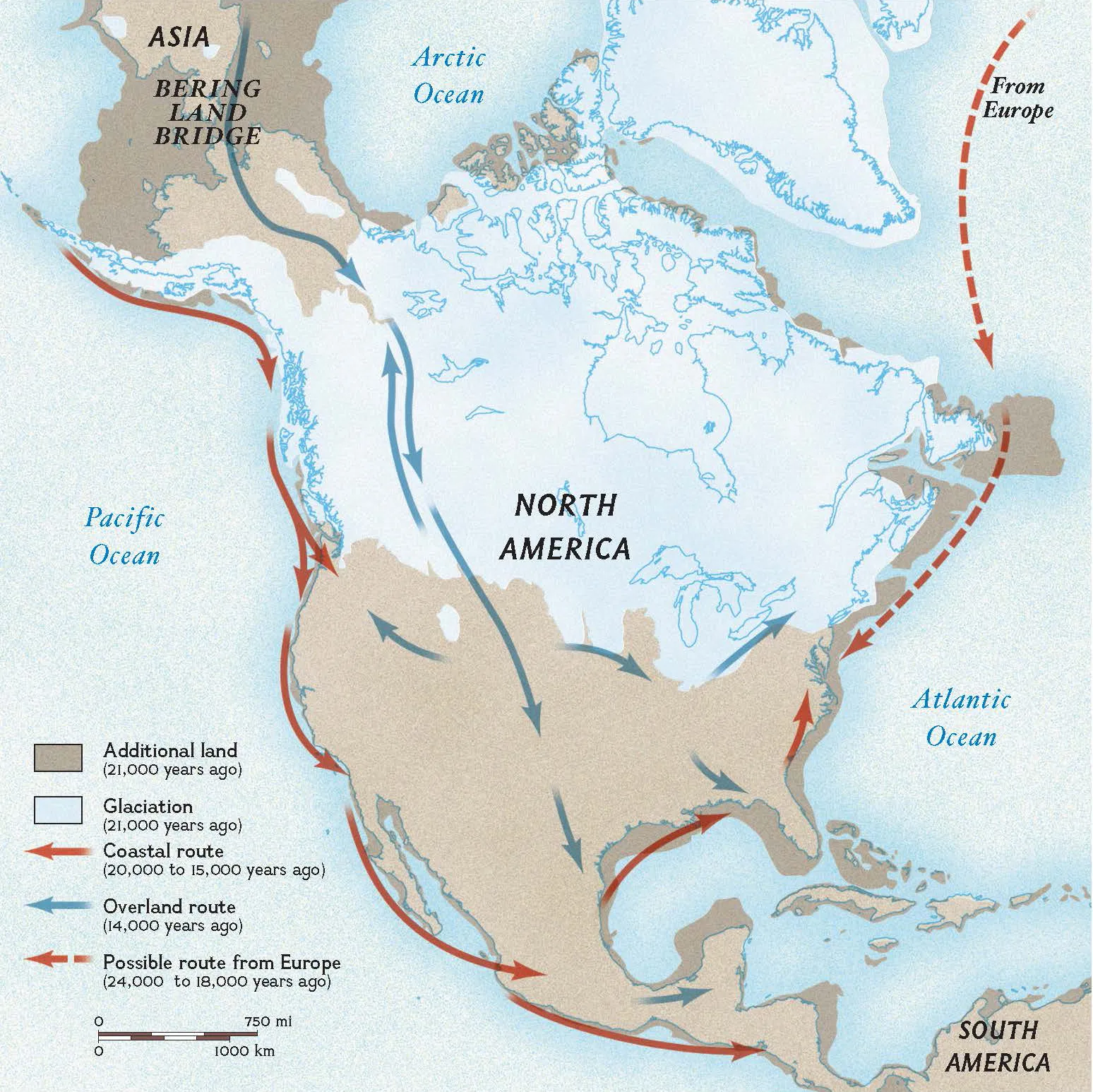
Long before roads crossed North America, a different kind of pathway stretched along the Pacific coast. Dense kelp forests lined the shoreline from Asia to the Americas, forming rich, stable ecosystems that may have guided the first human migrations. This idea, known as the Kelp Highway Hypothesis, suggests that early people traveled by sea, following these resource-rich environments.
First proposed in the 1970s and refined in 2007, the hypothesis argues that kelp forests provided reliable food and safer travel conditions. These underwater ecosystems supported fish, shellfish, marine mammals, and seabirds, while also calming ocean waves—making coastal travel easier. Unlike inland routes blocked by glaciers and shifting environments, the coast offered a more consistent path with fewer obstacles.
Archaeological evidence supports this idea. Sites like Monte Verde in Chile show early human presence over 14,500 years ago, with preserved seaweed remains confirming the use of marine resources. Along North America’s west coast, “Western Stemmed Points”—distinct stone tools dating back 16,000 years—appear before the inland Clovis culture and resemble tools from Northeast Asia, suggesting a Pacific connection.
Genetics adds another layer. Some Indigenous South American populations carry ancestry linked to ancient groups from Australasia, hinting at a rapid coastal migration. Even ancient dog remains from Alaska—dated to over 10,000 years ago—show a marine-based diet, reinforcing the idea of coastal living.
Despite this evidence, much of the story remains hidden. Rising sea levels have submerged ancient shorelines, burying campsites and artifacts underwater.
Today, many researchers believe the peopling of the Americas wasn’t a single journey. Instead, it likely involved multiple routes: coastal migrations along the Pacific, later movements through the ice-free corridor, and perhaps others. Rather than one path, it was a complex, layered process shaped by opportunity, environment, and survival.
Sources:
[1] George McJunkin and the Discovery That Changed American Archaeology
[2] Boldurian, A. 2008. “Clovis Type-Site, Blackwater Draw, New Mexico: A History, 1929-2009.” North American Archaeologist 29(1):65-89.
[3] C. Vance Haynes, Jr. 1964. “Fluted Projectile Points: Their Age and Dispersion.” Science145, 1408-1413.
[4] Holliday, V. T. 2020. “Geoarchaeology and the search for the first North Americans.” Geoarchaeology, 36(1), 3–17.
[5] Froese, D., et al. 2019. “AVAILABILITY AND VIABILITY OF THE ICE-FREE CORRIDOR AND PACIFIC COAST ROUTES FOR THE PEOPLING OF THE AMERICAS.” The SAA Archaeological Record.
[6] Dillehay, T., et al. 2015. “New Archaeological Evidence for an Early Human Presence at Monte Verde, Chile.” PLoS One 10(11):e0141923.
[7] Adovasio, J., et al. 1977. “Meadowcroft Rockshelter, 1977: An Overview.” American Antiquity. 1978;43(4):632-651.
[8] Pigati, J., et al. 2023. “Independent age estimates resolve the controversy of ancient human footprints at White Sands.” Science 382, 73-75.
[9] Bradley, B., & Stanford, D. 2004. “The North Atlantic ice-edge corridor: A possible Palaeolithic route to the New World.” World Archaeology 36(4), 459-478.
[10] Stanford, D. J., & Bradley, B. A. 2012. Across Atlantic ice: The origin of America's Clovis culture. University of California Press.
[11] Fisherman Pulls Up Beastly Evidence of Early Americans
[12] Cactus Hill Archaeological Site
[13] Lowery, D. 2021. “Parsons Island Maryland Synthesis of Geoarchaeological Investigations 2013-2020.” Chesapeake Watershed Archaeological Research
[14] Oppenheimer, S., Bradley, B., & Stanford, D. 2014. “Solutrean hypothesis: genetics, the mammoth in the room.” World Archaeology, 46(5), 752–774.
[15] Raff, J. A., & Bolnick, D. A. 2015. “Does Mitochondrial Haplogroup X Indicate Ancient Trans-Atlantic Migration to the Americas? A Critical Re-Evaluation.” PaleoAmerica 1(4), 297–304.
[16] Rasmussen, M., et al. 2014. “The genome of a Late Pleistocene human from a Clovis burial site in western Montana.” Nature 506, 225–229.
[17] Boulanger, M. 2015. “The Cinmar discovery and the proposed pre-Late Glacial Maximum occupation of North America.” Journal of Archaeological Science: Reports 2: 708-713.
[18] Westley, K., & Dix, J. 2008. “The Solutrean Atlantic Hypothesis: A View from the Ocean.” Journal of the North Atlantic 1, 85–98.
[19] O’Brien, M.,et al. 2014. “On thin ice: problems with Stanford and Bradley’s proposed Solutrean colonisation of North America.” Antiquity 88(340):606-613.
[20] Fladmark, K. 1979. “Routes: Alternate Migration Corridors for Early Man in North America.” American Antiquity 44(1), 55–69.
[21] Erlandson, J., et al. 2007. “The Kelp Highway Hypothesis: Marine Ecology, the Coastal Migration Theory, and the Peopling of the Americas.” Journal of Island and Coastal Archaeology 2(2), 161–174.
[22] Erlandson, J. M., et al. 2015. “Ecology of the Kelp Highway: Did Marine Resources Facilitate Human Dispersal From Northeast Asia to the Americas?” Journal of Island and Coastal Archaeology, 10(3), 392–411.
[23] Gonzalez-Aragon, D., et al., 2026. “Tracing the kelp highway hypothesis in South America: poleward shifts in kelp past distribution and archaeological evidence of human use.” Front. Ecol. Evol. 13:1720175.
[24] Dillehay, T., et al. 2008. “Monte Verde: Seaweed, Food, Medicine, and the Peopling of South America.” Science 320, 784-786.
[25] Davis, L., et al. 2019. “Late Upper Paleolithic occupation at Cooper’s Ferry, Idaho, USA, ~16,000 years ago.” Science 365(6456), 891–897.
[26] Pratt, J., et al. 2020. “A Circum-Pacific Perspective on the Origin of Stemmed Points in North America.” PaleoAmerica 6(1), 64–108.
[27] Castro e Silva, M., et al. 2021. “Deep genetic affinity between coastal Pacific and Amazonian natives evidenced by Australasian ancestry.” Proc. Natl. Acad. Sci. U.S.A. 118(14):e2025739118.
[28] Augusto da Silva Coelho, F., et al. 2021. “An early dog from southeast Alaska supports a coastal route for the first dog migration into the Americas.” Proc Biol Sci 288 (1945): 20203103.
Founder