
Did Humans Evolve in Water? (The Aquatic Ape Hypothesis)
Jul 13, 2026
By: Greg Schmalzel
Humans are not like other primates. Despite our genetic similarities to chimps, bonobos, and gorillas, we are seriously different. We’re mostly hairless. Beneath our skin lies a thick layer of subcutaneous fat, more like that of marine mammals. We can consciously control our breathing. And we’re the only animal that cries emotional tears. None of this fits the bill for a typical primate.
Individually, each of these traits could have their own evolutionary explanation. But together, they form a pattern that’s harder to ignore. Because when you step back and look at the human body as a whole, it begins to raise an uncomfortable question.
Why are we so different?
For decades, a small but persistent group of scientists and thinkers have proposed an answer - that we might actually be adapted to aquatic environments. It challenges everything we think we know about where we came from. The idea is so unusual, so controversial, that it’s often dismissed outright. And yet, it refuses to go away. Because if you follow these clues, it leads you somewhere unexpected. Not to the savannas of Africa, but to the water.
It’s called the aquatic ape hypothesis, but how does it stand up to the evidence? Let’s take a look for ourselves.
For the full YouTube video, click HERE.
Textbook Human Evolution
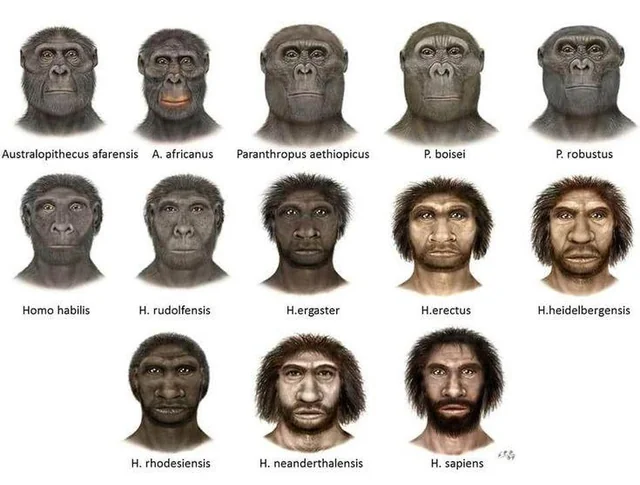
For more than a century, the story of human evolution has followed a familiar arc. As ancient climates shifted, dense forests across Africa began to thin and fragment. Our primate ancestors, once at home in the trees, were gradually pushed into expanding savannas. Survival now depended on adapting to life on the ground.
Those that could adapt endured. Over time, natural selection favored traits that define us today. Walking upright—bipedalism—allowed early humans to move efficiently across long distances while scanning above tall grasses. Freed hands could carry food, tools, and eventually weapons. Diets shifted as well, with greater access to meat providing the caloric boost needed to support growing brains. In turn, larger brains fueled advances in intelligence, social complexity, and communication.
In this classic narrative, nearly every major step in human evolution is tied to life on land—specifically, the open savanna. It is a story shaped by heat, scarcity, and wide, exposed landscapes. And while this model is compelling and supported by substantial evidence, it is not without its limitations. Like all scientific frameworks, it leaves questions unanswered—and invites us to look deeper.
What is the Aquatic Ape Hypothesis?
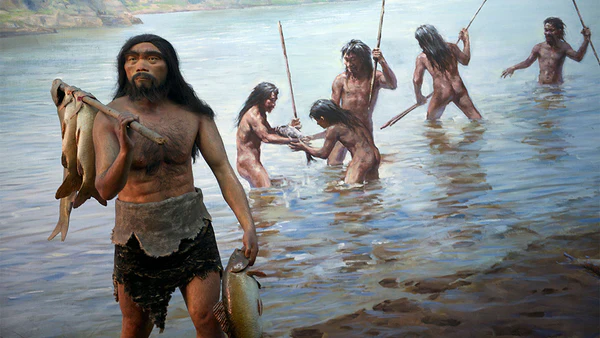
What if we flipped the script entirely? Instead of evolving solely on land, what if water played a central role in shaping who we are? This is the premise of the Aquatic Ape Hypothesis—the idea that our ancestors passed through a semi-aquatic phase, living along coasts and riverbanks, where swimming, wading, and foraging in shallow waters influenced evolution.
First proposed in the mid-20th century by thinkers like Alister Hardy, the hypothesis doesn’t claim we were fully aquatic, but rather something closer to amphibious. Proponents point to several “aquatic” traits in humans: our relative hairlessness, which may reduce drag in water; our unusually high levels of subcutaneous fat, potentially useful for insulation; and even our ability to consciously hold our breath—rare among primates but common in diving mammals.
Other clues are more subtle. Human infants display reflexive breath-holding in water. Our slight interdigital webbing hints at increased surface area for swimming. Even bipedalism, in this view, may have been advantageous for wading in shallow waters.
Taken together, these traits form a provocative alternative narrative. It’s bold, unconventional, and compelling—but like all hypotheses, it demands scrutiny. So the question becomes: do these traits truly point to a watery past, or can they be explained another way?
Debunking the Aquatic Ape Hypothesis
Marco Anson
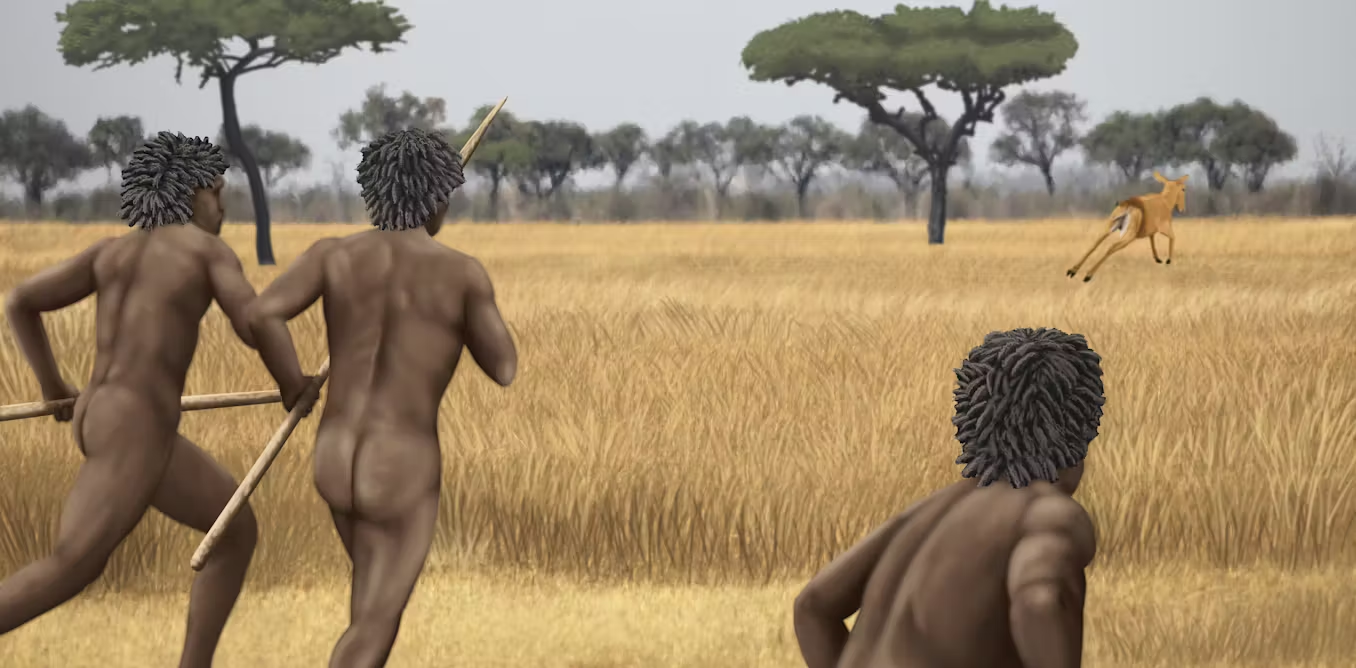
Many of the Aquatic Ape Hypothesis’s key traits can be explained without invoking a watery past. Take hairlessness—often cited as evidence of swimming adaptation. Around 2 million years ago, Homo erectus adopted an endurance-based hunting strategy known as persistence hunting. In the heat of the African savanna, losing body hair allowed sweat to evaporate more efficiently, preventing overheating during long-distance runs. In this context, hairlessness is far more useful for running than swimming.
Subcutaneous fat also has a simpler explanation. While it resembles marine mammal insulation, in humans it likely evolved as an energy reserve—fueling our unusually large, energy-demanding brains. This is especially critical in infants, who are born with far more body fat than other primates to support rapid brain growth.
Breath control, another “aquatic” trait, is better explained by the evolution of speech. Fossil evidence shows increased neural control over breathing in Neanderthals and modern humans, enabling the long, controlled exhales required for complex language.
Even infant “swimming” reflects basic survival reflexes, not aquatic ancestry. And emotional tears likely evolved as social signals on land, not in coastal waters.
Finally, fossil evidence shows bipedalism emerging in tree-filled environments—not oceans or shorelines—undermining one of the hypothesis’s central claims.
An Evolutionary Plot Twist
Wait, what about our slight webbing between fingers and toes? At first glance, it seems like a compelling aquatic clue—but the answer lies much deeper in our evolutionary past.
Every human embryo begins with fully webbed hands and feet. Early on, our fingers resemble paddles. Then a process called apoptosis removes most of that tissue, separating the digits. What remains is the small amount of webbing we see today. In rare cases, this process doesn’t fully complete, resulting in a condition called syndactyly—but that’s the exception, not the rule.
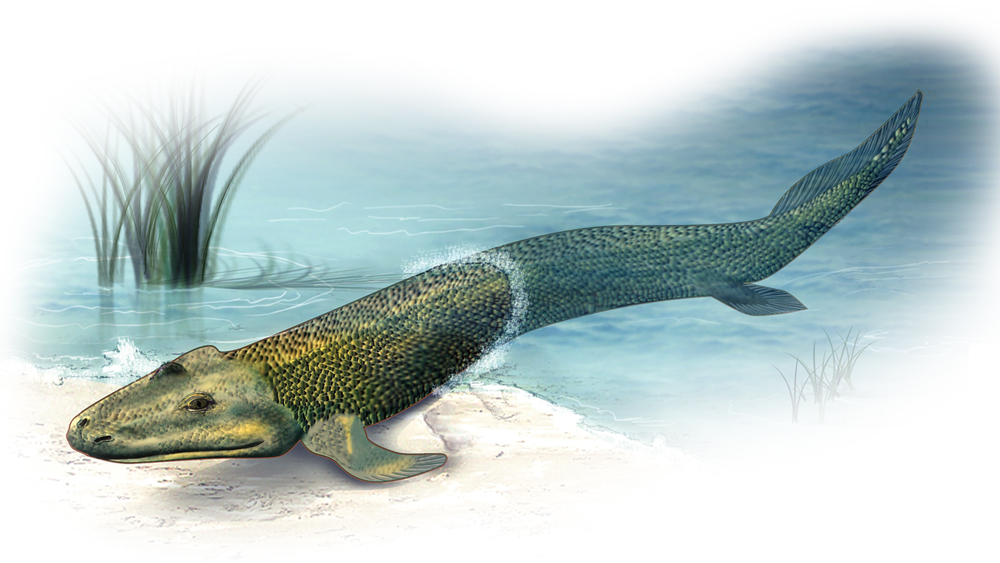
So why start with webbed “paddles” at all? The answer goes back over 400 million years. All land vertebrates, including humans, evolved from ancient fish with fin-like limbs. Fossils like Tiktaalik reveal how these structures gradually transformed into arms, hands, and fingers. Evolution doesn’t start from scratch—it modifies existing blueprints. Our embryonic webbing is not evidence of a semi-aquatic ape, but an echo of a far older, fish-like ancestor.
Ultimately, the Aquatic Ape Hypothesis falls short not because it explains nothing, but because it tries to explain too much. It bundles unrelated traits into a single narrative and relies heavily on features that don’t fossilize. Still, it hints at a deeper truth: if you go back far enough, we all come from the water.
Sources:
[1] Hardy, A. 1977. “Was there a Homo aquaticus?” Zenith 15(1):4-6.
[2] Hardy, A. 1960. “Was Man More Aquatic in the Past?” New Scientist 7, 642–645.
[3] Morgan, E. 1997. The Aquatic Ape Hypothesis. Souvenir Press.
[4] Bramble, D. and Lieberman, D. 2004. “Endurance running and the evolution of Homo.” Nature 432:345-352.
[5] MacLarnon, A. and Hewitt, G. 1999. “The evolution of human speech: the role of enhanced breathing control.” Am J Phys Anthropol. 109(3):341-63.
[6] Thelen, E., et al. 2002. “The Relationship between Physical Growth and a Newborn Reflex.” Infant Behavior and Development 25(4):479-493.
[7] Tursic, A., et al. 2022. “The power of tears: Observers' brain responses show that tears provide unambiguous signals independent of scene context.” Neuroimage Rep. 2(3):100105.
[8] Scott A. Williams et al. 2026. “Earliest evidence of hominin bipedalism in Sahelanthropus tchadensis.” Sci. Adv.12, eadv0130.
[9] White, T., et al. 2009. “Ardipithecus ramidus and the Paleobiology of Early Hominids.” Science 326(64):75-86.
[10] Böhme, M., et al. 2019. “A new Miocene ape and locomotion in the ancestor of great apes and humans.” Nature 575(7783):489-493.
[11] Le Fur, S., et al. 2009. “The mammal assemblage of the hominid site TM266 (Late Miocene, Chad Basin): ecological structure and paleoenvironmental implications.” Naturwissenschaften 96(5):565-74.
[12] Dericquebourg, P., et al. 2015. “Environmental significance of Upper Miocene phosphorites at hominid sites in the Lukeino Formation (Tugen Hills, Kenya).” Sedimentary Geology 327:43-54.
Founder