
Archaeologists Say These Artifacts Shouldn’t Exist
Jun 15, 2026
By: Greg Schmalzel
These two artifacts are separated by thousands of miles. And yet, they look almost identical. One comes from the United States, where it’s tied to some of the earliest people in the Americas. This technology is so distinctive, so difficult to produce, that archaeologists have long treated it as a kind of cultural fingerprint. But the other comes from Arabia, and it’s eerily similar.
To create these stone points involved the same techniques, the same flake removed from the base, and possibly the same solution to a very specific engineering problem. Yet, they appear in completely different parts of the world.
And that creates a serious archaeological problem. Because as far as the traditional narrative goes, projectile points like these should only be found in the Americas. And as far as we understand, there is no direct connection between the Americans who crafted them and Arabia. There was no clear migration, shared tradition, or obvious pathway for this idea to have spread.
So what are we looking at? Did this technology somehow travel across continents in ways we haven’t pieced together? Or did different human groups arrive at the exact same ancient innovation? Before we dive into this mysterious connection, I wanna know what you think. Comment your initial thoughts or theories below, and by the end of the video, let’s see if you’ve changed your mind.
For the full YouTube video, click HERE.
Fluted Points in America
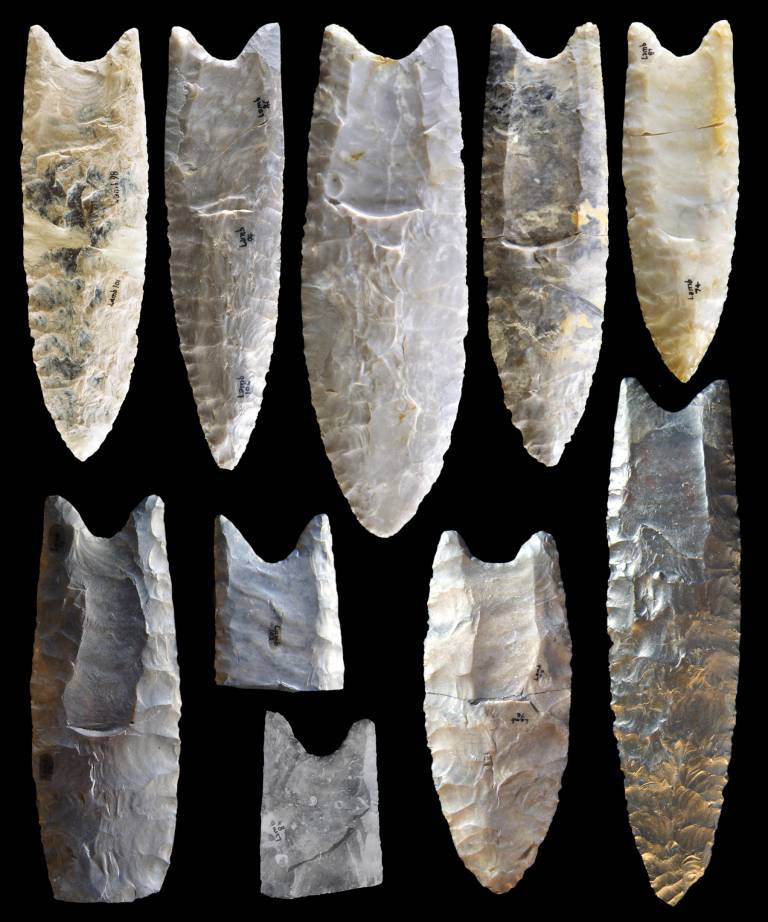
At its core, a fluted point is a stone spear or dart tip with a long, thin flake removed from the base. That removal—called a flute—creates a channel running up the center. It gives the tool a distinctive, almost iconic shape. Once you recognize it, you start seeing it everywhere—and wondering how and why it was made. Most people associate fluted points with Clovis, the Ice Age culture that appears in North America just before 13,000 years ago. These were highly mobile hunter-gatherers, likely pursuing massive animals like mammoths across the continent. Their points were large, leaf-shaped, and fluted about halfway up. But while Clovis marks the beginning of this technology, it doesn’t mark the end.
After Clovis disappears, fluting continues—and evolves. The Folsom culture refines the technique, producing smaller, thinner points with flutes that often run nearly the entire length. It’s a riskier, more precise version of the same idea. Other regional styles emerge too, each with distinct shapes but the same underlying feature: the flute. From North America to South America, these points spread across cultures and landscapes. They vary in form, but share a common technological signature.
So this isn’t just a tool.
It’s a marker of identity—one that connects different groups across time and space through a shared, and surprisingly complex, tradition.
Fluted Points in Arabia
Crassard et al
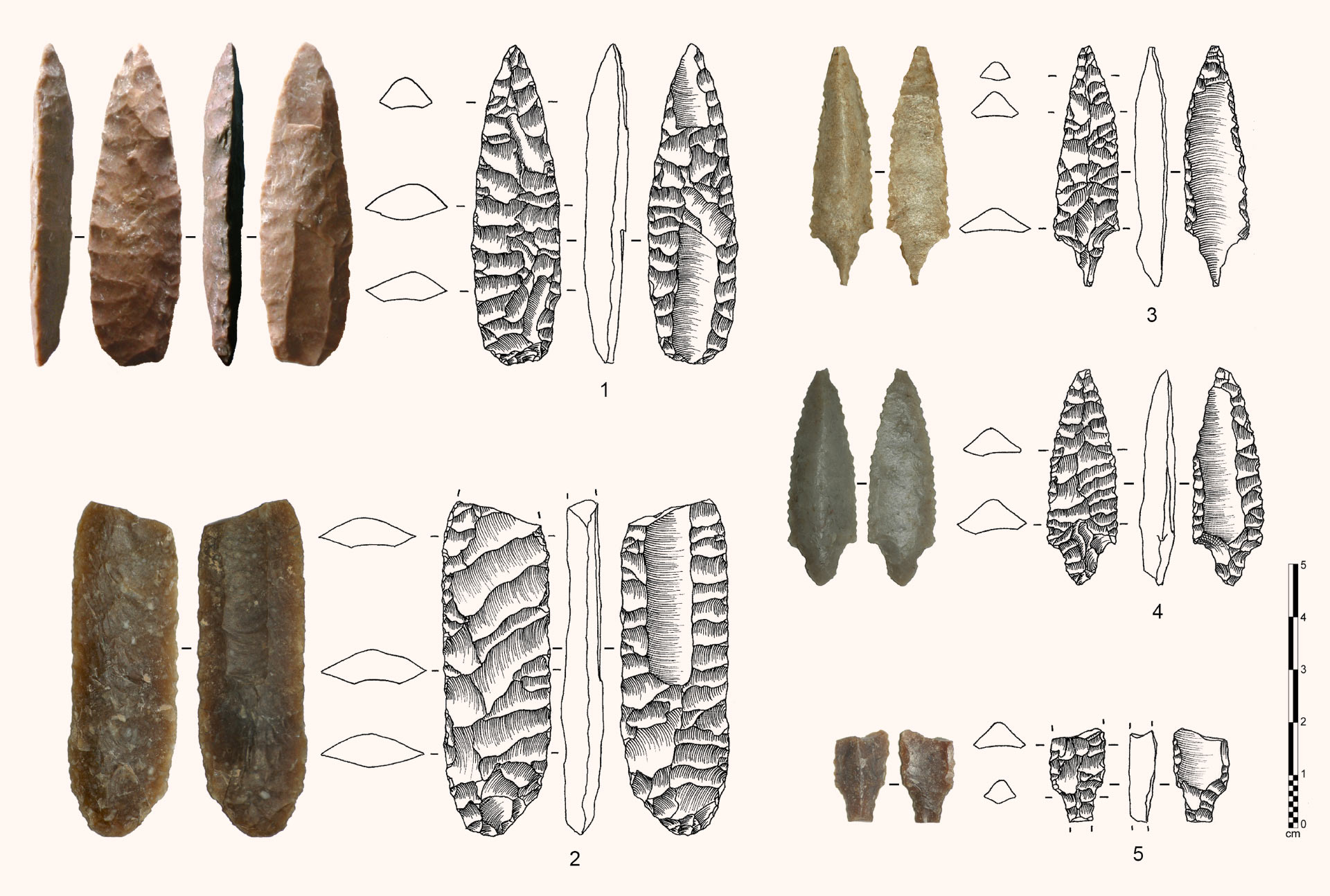
However, what I’m about to show you is much harder to explain. By around 10,000 years ago, fluted technology disappeared in the Americas, replaced by entirely different projectile point styles. But then—thousands of years later—it shows up again. Not nearby. Not as a continuation. But on a completely different continent. In the early 2000s, archaeologists began identifying fluted points in southern Arabia, specifically in parts of Oman and Yemen. And somehow, this hasn’t become a bigger conversation. Even within archaeology, it’s easy to miss. Despite decades of discussion around Clovis and fluting in the Americas, this parallel discovery has remained oddly under the radar.
Discovered in 2004 in Yemen’s Wadi Sana valley, the stratified Manayzah Rockshelter provides a rare look at prehistoric fluted technology, with 2.2 meters of buried, radiocarbon-dated layers. Excavations uncovered a specialized workshop, revealing that the 8,000–7,700-year-old trihedral, fluted points represent a local, independent Neolithic tradition, rather than a connection to American, Levantine, or Arabian cultures. The site suggests inhabitants were transitioning from hunting gazelle to early pastoralism with sheep and cattle.
In the Dhofar region of Oman, the site of Hailat Araka reveals that during the Early Holocene, increased rainfall transformed today's desert into a lush savannah. Excavations uncovered a 7,160-year-old layer with thousands of artifacts detailing every stage of flintknapping. The fluting technology here was part of the trihedral tradition closely tied to Yemeni points. However, local variations like unique base notches and serrated edges emerged later than those at Manayzah. The inland Oman population engaged in long-distance trade, importing Southwest Arabian obsidian, steatite, amazonite, and Indian Ocean marine shells for ornamental pendants and bracelets.
Because both regional groups utilized outsourced materials, they likely interacted along seasonal travel and trade routes. In these small, mobile societies, the complex fluted technology likely spread through demonstration, imitation, and social networks.
Cultural Evolution, Convergent Evolution
Independent global developments, rather than lost civilizations, are best explained by convergent evolution. In biology, this process occurs when unrelated organisms independently evolve similar traits to adapt to comparable environments or ecological pressures.
For instance, sharks and dolphins share sleek bodies and fins despite being fish and mammals, respectively. Similarly, birds and bats independently developed entirely different wing structures for flight. Eyes also evolved from scratch dozens of times; humans and octopuses both possess complex camera eyes, but their distinct internal wiring proves they arrived at this design through unique paths.
Human culture functions in much the same way, as isolated populations develop parallel tools and practices to adapt to their environments. For example, humans in the Fertile Crescent, Mesoamerica, and China independently invented agriculture 10,000 years ago without any contact. The bow and arrow was also invented multiple times across the globe as the optimal mechanical solution for long-distance hunting.Furthermore, ancient Egyptians, Maya, and Mesopotamians all built pyramids because stacking stones with a wide base narrowing to the top is simply the most stable pre-industrial engineering method for ultra-tall structures. Even complex ideas converge; Charles Darwin and Alfred Russel Wallace simultaneously developed the theory of evolution by natural selection while working in total isolation because they were exposed to the same foundational scientific literature.
Applying this to fluted points, their appearance in both the Americas and Arabia is most likely an example of cultural convergent evolution. While the technology was not an inevitable development—since most global cultures never created it—the parallel breakthrough demonstrates that distinct human groups with exceptional flintknapping skills could independently arrive at the same advanced engineering solution.
Why Flute?

While archaeologists often restrict fluting technology to the Americas, evidence from Arabia disproves this claim. However, despite the structural similarity, researchers argue the two cultures fluted their points with entirely different intentions.In the Americas, Clovis fluting served a purely functional, utilitarian purpose. Thinning the point's base allowed for easier hafting onto spear shafts and improved penetration into large game, acting as an engineered survival strategy.
Conversely, Neolithic Arabian sites lack evidence of big-game hunting, and many trihedral points were never fluted. Furthermore, Arabian flutes often appeared at the tip rather than the base, making them useless for hafting.
Instead, Arabian fluting served a social purpose, acting as a high-risk display of elite craftsmanship. By executing this difficult technique, skilled artisans demonstrated technical mastery to garner social prestige, reputation, and trust within mobile groups.Ultimately, this parallel technology is more than simple convergent evolution. It reveals that ancient innovation was not always driven by survival or efficiency. Instead, technology could serve as a deeply human tool for signaling status and competence.
Sources:
[1] Waters MR, et al. 2020. “The age of Clovis-13,050 to 12,750 cal yr B.P.” Sci Adv. 6(43):eaaz0455.
[2] Surovell, T., et al. 2016. “On the Dating of the Folsom Complex and its Correlation with the Younger Dryas, the End of Clovis, and Megafaunal Extinction.” PaleoAmerica 2(2):81-89.
[4] Redstone Fluted
[5] Prates, L., et al. 2022. “Changes in projectile design and size of prey reveal the central role of Fishtail points in megafauna hunting in South America.” Sci Rep. 12(1):16964.
[6] Prates, L. and Perez, I. 2021. “Late Pleistocene South American megafaunal extinctions associated with rise of Fishtail points and human population” Nature Communications 12 (1): 2175.
[7] Crassard, R., et al. 2020. “Fluted-point technology in Neolithic Arabia: An independent invention far from the Americas.” PLOS ONE 15(8): e0236314.
[8] Crassard, R. 2009. “Modalities and characteristics of human occupations in Yemen during the Early/Mid-Holocene.” Comptes Rendus. Géoscience 341(8–9):713-725.
[9] Zarins, J. 2013. “Hailat Araka and the South Arabian Neolithic.” Arabian Archaeology and Epigraphy 24(1):109-117.
Founder