
A Perfect Storm for Calamity
Sep 28, 2026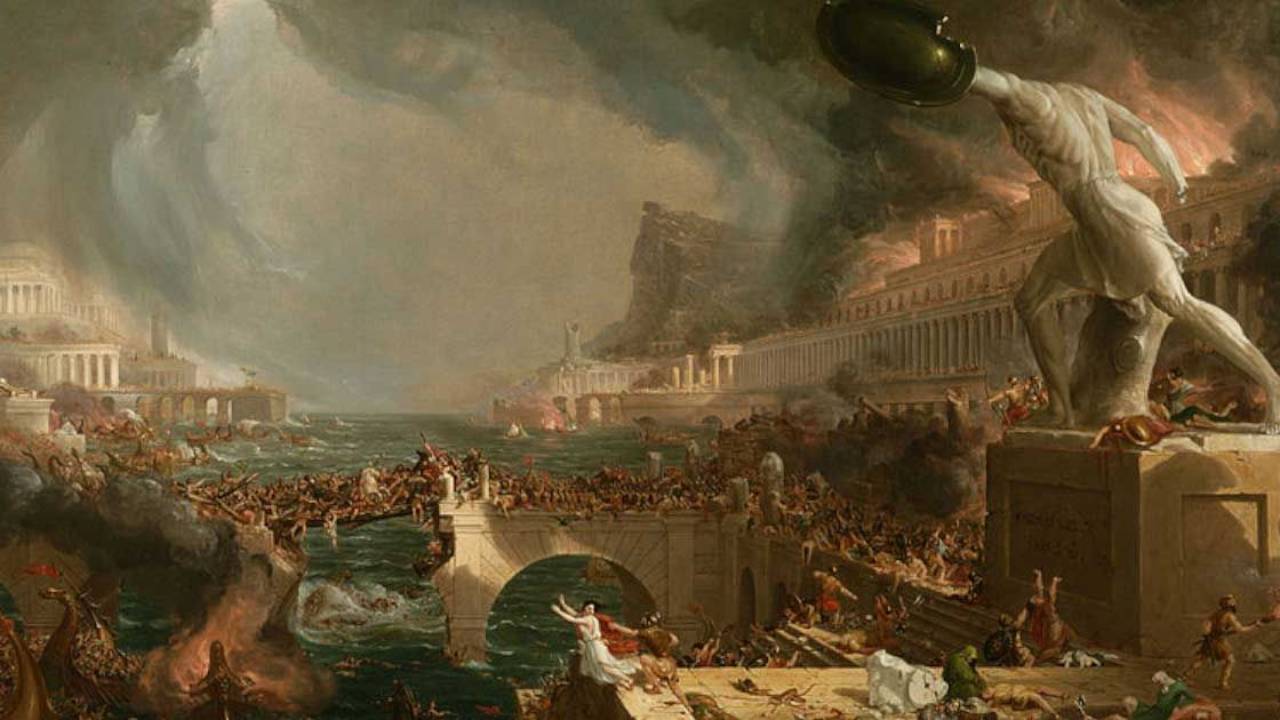
The Sea Peoples, Systemic Collapse, and the End of the Bronze Age
By: Matt Kramer
Flames spread out across the palace, lapping hungrily at the timbered walls, voraciously expanding outward. From the coasts of Greece to the gates of Syria, mighty palatial cities are put to the torch, their populations scattered, and their treasures looted by a relentless, shadowy coalition of sea-raiders hellbent on tearing down civilization as the ancient world knew it. The Bronze Age kingdoms of the Near East were in flames, and within a matter of decades, the most sophisticated and connected kingdoms ever before seen in history vanished into ash.
As carved into the stone walls of Ramesses III’s mortuary temple at Medinet Habu: “The foreign countries made a conspiracy in their islands [or lands]. All at once the lands were removed and scattered in the fray. No land could stand before their arms, from Khatte, Qode, Carchemish, Arzawa, and Alashiya on, being cut off at [one time]. A camp [was set up] in one place in Amurru. They desolated its people, and its land was like that which has never come into being. They were coming forward toward Egypt, while the flame was prepared before them. Their confederation was the Peleset, Tjekker, Shekelesh, Danuna, and Weshesh, lands united. They laid their hands upon the lands as far as the circuit of the earth, their hearts confident and Trusting.”
By chronicling the pillaging and havoc inflicted on the Hittites (Khatte), Qode (southeastern Anatolia), Carchemish (northern Syria), Arzawa (western Anatolia), and Alashiya (Cyprus), the Egyptians documented the first historical record of the coalition of the foreign invaders. They would later be dubbed the infamous “Sea Peoples” by modern historians. While the Sea Peoples were wreaking havoc across the Near East, Egypt was preparing. Inscriptions on the exact same mortuary temple walls also detail the great Egyptian triumph over this group of marauding peoples in 1177 BCE. While Egypt secured their place as a major power in the world, unlike many of their contemporaries, the victory was a pyrrhic one. Shortly after, Egypt’s power began to decline, never again reaching the past glories they achieved during their New Kingdom dynasty from the mid to Late Bronze Age.
The Sea Peoples as chronicled at Ramesses III’s mortuary temple at Medinet Habu
In boasting of his accomplishment, Ramesses III inadvertently established a long-standing historical narrative. He framed these raiders as a single, bellicose force that orchestrated the demise of the ancient world's great powers: pillaging coasts, burning cities, and dragging an entire global system down with them. For most of the 19th and 20th centuries, this was the dominant explanation pushed by archaeologists and historians. An open-and-shut case that proved the Sea Peoples to be the aggressor, and the great powers a victim of their wrath.
The truth, however, is far more terrifying than a foreign invasion. The Sea Peoples were likely a symptom of the collapse; the ones who perhaps shoved the last domino over, but they themselves were among the first dominos to fall in the beginning. To better understand how a world burned, we must first understand how it was built and how it functioned.
The Age of Bronze
Map of the Late Bronze Age Near East showing the major powers and regional trade networks. (Image: Nick Nutter, Nutters World).
The Bronze Age in the Near East featured a variety of different kingdoms, vassal states, and trading cities that all displayed varying degrees of power and servitude. At the top of this power struggle, and at the peak of their influence during this time, were the Egyptians. Powerful and still well-known rulers like Amenhotep III to Akhenaten, Nefertiti, and King Tut dominated Egypt and most of the Levant for hundreds of years. It wasn’t until the battles with the Sea Peoples in 1177 BC and the collapse of the major powers around them that Egypt started to decline as well. This hyper-connected network stretched across the entire Eastern Mediterranean, anchored by a few major empires. In Anatolia sat the Hittite Empire, while the Assyrians and Kassite Babylonians held sway over the rivers of Mesopotamia. Out to the sea, the island of Cyprus (known anciently as Alashiya) served as a bustling hub of copper and commerce. Across the Aegean, the Minoans of Crete and the Mycenaean palatial states of mainland Greece dominated the maritime trade routes.
For centuries, this vast network represented a true high-water mark in human development, an era of great cities crowned with ornate palaces, unprecedented urban sophistication, and a golden age of wealth, writing, trade, and long-distance communication (Carlin 2019).
The Bronze Age was an age of gods, demigods, and immense pride for the civilizations that followed in its footsteps. Centuries later, the classical Greeks who inhabited the region looked upon the ruined stone fortresses at Mycenae and believed they were built by giants, lacking the engineering know-how to construct cities so mighty. Events from this era, most famously the fall of Troy chronicled in Homer’s Iliad, molded themselves into the very psyche of the people who cherished those stories. When Alexander the Great invaded Asia Minor in the 4th century BCE, some 800 years after the likely date of the Trojan War, his very first stop was to pay respect to the ruined city of Troy. When people think of history today, it is almost always viewed through a modern lens, but to people living thousands of years ago their own history mattered deeply. To later generations, the Bronze Age Collapse was not merely a shift in economic trade, but the tragic end of a heroic age.
The First Global Economy
This unprecedented era was anchored by a complex, global network of interdependence. As archaeologists Kristian Kristiansen and Paulina Suchowska-Ducke (2015) point out, the Bronze Age was the first epoch in history where societies became irreversibly bound together because the raw materials needed for bronze, specifically copper and tin, were unevenly distributed across the map. To secure these critical resources, states could not rely on local extraction alone; they had to construct vast physical trade routes and maintain diplomatic alliances cemented through gift-giving, royal marriages, and economic treaties.
The strategic importance of tin and copper in the ancient world was remarkably similar to the strategic importance of oil today. This is exemplified by the Uluburun shipwreck discovered off the coast of Turkey. This Bronze Age vessel probably set sail from Cyprus or the northern Levant and was likely bound for the Aegean, perhaps heading to one of the Mycenaean palaces. Rather than representing a standard merchant voyage, scholars hypothesize that the ship was part of a high-level diplomatic gift exchange between Bronze Age powers. To get a sense of the scale and variety of goods moving across the Near East during this era one only needs to look at what archaeologists uncovered in its hold: 354 copper ingots (weighing 10 tons); 1 ton of tin ingots; 175 glass ingots in vibrant turquoise, cobalt, amber, and purple; 1 ton of terebinth resin (likely used for perfumes or incense); hippopotamus and elephant ivory; and various storage jars containing preserved fruits and spices (Cline 2014).
In our modern economy, we see how easily supply bottlenecks, embargoes, and trade disruptions in the energy sector can ripple outward, affecting everyday life in immediate and tangible ways. A similar vulnerability plagued the ancient world, where every major Bronze Age power relied on a continuous, uninterrupted supply of foreign metals to fuel their economies and equip their armies. When climate stress, piracy, or regional conflicts fractured these delicate trade corridors between 1300 and 1100 BCE, the entire network suffered a catastrophic, systemic breakdown.
As archaeologist Eric H. Cline points out, this was a fully integrated, globalized world system for its time, where sovereign powers were just as dependent on one another as nations are today. Kings across the Mediterranean communicated constantly, exchanging royal daughters in marriage, dispatching diplomatic emissaries, and addressing each other as “brothers” bound by mutual need.
Here is a primary example of a Bronze Age tablet that captures the essence of how sovereign rulers communicated, featuring a letter from the King of Alashiya (Cyprus) to the Pharaoh of Egypt:
“Say to the King of Egypt, my brother: Thus speaks the King of Alashiya, your brother. All is well with me... Behold, I send to you five hundred weight of copper; as a gift for my brother I send it to you. My brother, do not take it to heart that the amount of copper is small, for in my land the hand of Nergal [pestilence] was upon my land; all the men of my land were slain, and there was no one to produce copper. But my brother, do not take it to heart. Send your messengers with my messengers quickly, and I will send you whatever copper you desire, my brother.”
— Amarna Letter EA 35 (c. 1350 BCE)
The Sea Peoples
The concept of the “Sea Peoples” is largely an Egyptian label, as it represented the specific coalitions that Egypt faced at their borders, including groups like the Peleset, Shekelesh, Sherden, Denyen, and Tjeker, though the composition of these migrating raiders likely changed across different waves. What history has recorded as sudden invasions may often have been large-scale migrations, and what is traditionally portrayed as entire populations moving at once was likely a process of gradual, long-term immigration. According to Israel Finkelstein of Tel Aviv University, the migration was not a single, isolated, or even necessarily planned invasion in 1177 BCE, but a long, multi-stage process spanning over half a century (c. 1207–1130 BCE) (Cline, 2014).
This idea is not at all surprising as there are countless examples throughout human history of large groups migrating in search of new opportunity, fertile lands, or escape from hardship. The Jewish Exodus from Egypt serves as one of history's most famous contemporaneous examples of mass migration, occurring right at the end of the Bronze Age.
Moving back to this idea of different migrations (or invasions, depending on what side you’re on), it appears clear that early waves of the “Sea Peoples” struck along the Levantine coast and were repelled by Ramesses III. Later groups in the mid-twelfth century BCE eventually terminated Egyptian rule in southern Canaan, settling in Philistia and establishing major centers at Ashdod, Ashkelon, and Ekron. Some of these settlers were the Peleset, who we know today as the Philistines.
Speaking of the Philistines and the cities they established in the Levant, they are the only “Sea Peoples” group we can trace with near certainty, and they are almost certainly of Aegean descent based on their material culture, ceramics, and more recent ancient DNA testing (Cline 2014).
Most scholars tend to agree the overall material culture of the Sea Peoples points to origins scattered across the Aegean, Western Anatolia, and Cyprus. Despite the possibility of them originating in these lands, it is very probable that it was the fall of the powerful Mycenaean and Hittite empires that actually fueled their migration, rather than the Sea Peoples being the ones who caused these empires to crumble (which will be expanded on in just a bit). It is likely that these migrants were simply farmers and commoners who left the corpses of their once-great kingdoms and banded together out of sheer necessity to survive.
Map of the Late Bronze Age collapse (c. 1250–1100 BCE) showing trade routes, destruction sites, and migration corridors across the Eastern Mediterranean. (Image: Simeon Netchev, World History Encyclopedia).
Famine and Drought
Nothing motivates movements of large groups of people more than necessity. When people don’t have enough food to feed themselves, let alone their family, they might have to leave their home and head for literal greener pastures. Drought and famine have long been suggested as a major contributing factor to the Bronze Age Collapse, and it is easy to see why. Before modern technological advancements and archaeobotany provided physical climate data, historians relied heavily on cuneiform tablets describing these desperate conditions firsthand. Letters from this period reveal a region on the brink of starvation. A Hittite queen famously wrote to Pharaoh Ramesses II pleading for help, stating flatly, “I have no grain in my lands,” while tablet RS 20.212 from Ugarit records a frantic plea from the Hittite king demanding an urgent shipment of grain, stating, “It is a matter of life or death!” (Cline 2014).
The climate data from pollen cores at Hala Sultan Tekke in Cyprus, alongside coastal Syrian records from Gibala-Tell Tweini, reveals that the abrupt drought and resulting famine hit the entire Eastern Mediterranean region around 1200 BCE. This multi-century dry spell crippled rain-fed agricultural systems across the Aegean (mainland Greece and Crete), Anatolia (the Hittite heartland), the northern and southern Levant (Syria and Canaan), and Cyprus (Kaniewski et al., 2013).
This drought extended far beyond Syria and Cyprus; pollen records from the Sea of Galilee and the Dead Sea show a sudden drop in native Mediterranean trees between 1250 and 1100 BCE, proving the entire Southern Levant was ecologically crippled (Langgut et al.,2013). Furthermore, while Egypt relied on the Nile rather than local rainfall and was spared the immediate loss of crops, the surrounding major powers, particularly the Hittites in modern-day Turkey and the city-states of Syria, suffered severe, long-term food shortages that undermined their central governments right before the physical destruction of their cities. It is very likely that drought and famine were core factors not only in the decline of these civilizations, but also in driving the movements of the so-called Sea Peoples, migrants dispersing throughout dwindling empires, desperate for a better opportunity to survive.
Earthquakes, Abandonment, and Systems Breakdown
In keeping with the title of this article, there is ample evidence that the end of the Bronze Age truly was a perfect storm, with Mother Nature becoming more and more the primary culprit. As if famine and drought were not tumultuous enough for these kingdoms, she threw a curveball, or more aptly, a sequence of curveballs, in the form of earthquakes. Research indicates that a series of catastrophic earthquakes struck mainland Greece, the Aegean, and the Eastern Mediterranean between roughly 1225 and 1175 BCE: a fifty-year “earthquake storm” that tore through physical infrastructure when these societies were already on the decline due to severe drought and famine (Cline, 2014).
Much like modern economic systems, these Late Bronze Age states relied heavily on uninterrupted supply lines, causing rapid instability whenever logistical networks faltered. To this point, archaeological evidence shows that many sites were not actually burned to the ground by invading raiders at all; rather, they were simply abandoned by populations fleeing systems that could no longer support or protect them (Cline, 2014).
The Lion’s Gate at Mycenae showing bedrock displacement and wall misalignment caused by earthquake activity. (Image: Keep Talking Greece).
Standing on the Tracks
For more than three centuries during the Late Bronze Age, the Mediterranean played host to a complex international world where Minoans, Mycenaeans, Hittites, Assyrians, Babylonians, Mitannians, Canaanites, Cypriots, and Egyptians interacted in a globalized network unlike anything seen before in human history. Kingdoms traded precious goods, built intricate and sophisticated cities, and forged diplomatic alliances sealed through royal marriages. Yet, this intense mutual reliance eventually became their undoing. These cultures were so intertwined that the collapse of an empire hundreds of miles away could trigger a ripple effect that ultimately dragged down the rest. Future archaeological discoveries and continued advancements in paleoclimate and ancient DNA studies will undoubtedly shed even more light on this chaotic era. But as the evidence stands today, the Bronze Age Collapse was not the sole work of the marauding and empire-defying “Sea Peoples,” but rather a vicious cocktail of warfare, drought, famine, earthquakes, and systemic over dependence.
While having a single cause or a scapegoat can be the most parsimonious and reassuring answer to the collapse of complex global ecosystems, it is vital that we see this as another example of how complicated history and global networks can be. Just like how Rome wasn’t built in a day, Bronze Age kingdoms in the Near East didn’t collapse in a day or even a few years. It was a slow, suffocating strangle in the form of disrupted trade networks, natural disasters, and displaced peoples rather than a cataclysmic event that ends the world as we know it overnight. It is the slow creep toward impoverishment and hunger, toward severed global connections, and a little help from Mother Nature that pushed these civilizations over the Brink.
Every major civilization before us has eventually collapsed, yet we often live under the dangerous illusion that ours is somehow immune. We take for granted the invisible webs that sustain us and hold the collective fabric of our existence together. At a micro scale, the average person trusts that they can walk into a grocery store tomorrow and find food for their family, or that at the flip of a switch they can reliably heat their home and power their refrigerator. On a global scale, modern nations operate on that same implicit trust, relying on open trade networks to supply essential goods they cannot produce themselves. But when these critical supply chains fracture, widespread turmoil follows quickly behind.
Looking back at the Late Bronze Age reminds us that relying on simple scapegoats masks real systemic threats, leaving us blind to how quickly complex systems can unravel. Presenting our best understanding of these intersecting factors shows that no society is invulnerable. But unlike the ancient Hittites, who had no way of understanding why a multi-century drought was happening or how to mitigate it, modern society possesses the data, technology, and resources to recognize global threats like climate change on the horizon, and the responsibility to act before our own systems fracture. We like to think we’re too smart for an apocalypse, standing safely on the tracks while we wait for the future to roll in. But as history keeps trying to tell us, that light at the end of the tunnel might just be the train.
Sources:
Carlin, D. (2019). The end is always near: Apocalyptic moments from the Bronze Age collapse to nuclear near misses. Harper.
Cline, E. H. (2014). 1177 B.C.: The year civilization collapsed. Princeton University Press.
Kaniewski, D., Van Campo, E., Guiot, J., Le Burel, S., Otto, T., & Baeteman, C. (2013). "Environmental roots of the Late Bronze Age crisis." PLoS ONE, 8(8), e71004.
Kaniewski, D., Van Campo, E., Van Lerberghe, K., Boiy, T., Vansteenhuyse, K., Jans, G., Nys, K., Weiss, H., Morhange, C., Otto, T., & Bretschneider, J. (2011). "The Sea Peoples, from
cuneiform tablets to carbon dating." PLoS ONE, 6(6), e20232.
Keep Talking Greece. (2018, April 10). The Lion’s Gate at Mycenae bedrock displacement. Keep Talking Greece.
Kristiansen, K., & Suchowska-Ducke, P. (2015). "Connected histories: The dynamics of Bronze Age interaction and trade 1500–1100 BC." Proceedings of the Prehistoric Society, 81, 361–392.
Langgut, D., Finkelstein, I., & Litt, T. (2013). "Climate and the Late Bronze collapse: New evidence from the southern Levant." Tel Aviv, 40(2), 149–175.
Netchev, S. (2022, June 29). Map of the Late Bronze Age collapse & transformation, c. 1250– 1100 BCE. World History Encyclopedia.
Nutter, N. (2020). Map of the Late Bronze Age Near East. Nutters World.
Founder